Milo Fine
Graham Lock
Thom Jurek
Derek Taylor
Tim Niland
Tom Hull
Markus Müller
Thomas Wörtche
Milo Fine
Though crossing paths, Evan Parker’s approach to playing is at the opposite end of the spectrum from Brötzmann’s, Parker’s essentially a scientist who, in refinding the passionate squealing bombast of Albert Ayler, Pharoah Sanders and Herr Brötzmann, thereby turning the acoustic possibilities of the saxophone inside out, set the stage for contemporary reed stylists. When playing solo soprano sax, he, like Taylor, continues to impose successful variations on his unique multi-line multiphonic style. In other contexts over the last decade however, he at times works within distinct, seemingly predetermined parameters that, in their meticulousness, don’t always serve the music at hand. One constrain involves timbral/dynamic limits, such as the mid-range sputtering tenor employed in an encounter with Taylor and cellist Tristan Honsinger which, in that context, was rather uninvolving. Another utilizes Parker’s uncanny mockingbird abilities. As part of his having achieved a singular voice, Parker is seemingly able to go toe-to-toe with, and in, anyone else’s jazz-based style. (This probably extends to most genres of music, but he’s yet to be documented in a polka or country context.) As stated in a review of “Duets, Dithyrambisch”, he never mimics cruelly, but rather in the spirit of finding a common point of departure. (He is much more a blender than a contrapuntalist.). Such is the case on this reissue where he mines Lacy’s angular Monk’s intervallic lines with great facility and to good effect. As for Lacy, the indefatigable elder statesman of the straight horn has spent much of the last decade pulling his ensemble conception inside – the angles of his tunes have become less harsh, the arrangements (save for larger works) more fundamental and the rhythm more obviously swinging. Still, much of what he produces continues to be stimulating with releases such as this, on smaller labels, generally being the best of the lot. And though it is lamentable that Parker didn’t choose to interject more of his patented stylings into Lacy’s conception, the conversations here, including the additional 3 on the CD release are nonetheless thoughtful, satisfying musical dialogues.
from: Cadence Magazine # 5, May 1992
Graham Lock
If you like the sound of sopranos, you’ll love Chirps, the CD reissue of a 1985 duo improvisation concert with Evan Parker which has the three tracks – totaling approximately 17 minutes – not included on the earlier LP release. Chirps is an appropriate title as the two sopranos chorus melodiously and weave in delicate flight around each other like a pair of canoodling swallows. The extra tracks, recorded after the audience had left, offer more of the same – great if you like it, though, to quote a colleague, “too much of this music makes me feel dizzy”!
from: The Wire # 87, September 1991
Thom Jurek
This must have been a hell of a concert to see. In 1985, Steve Lacy went to Berlin to play four different concerts, all of them duets with a different partner. Two of them were with pianists, one was with a dancer, and the last was with fellow soprano saxophonist Evan Parker. Given Lacy's gargantuan stature as the foremost jazz soprano saxophonist in the world, and Parker's as the most important member of the British free jazz and new music scene with the exception of Derek Bailey, this had the potential to be one hell of a show. If this recording is any indication of what that evening was like, then it was all that and more. Apparently, each player had the opportunity to play a solo set before this encounter took place. When the two men joined, magic happened. Both players, rather than come out steaming or with deference to the other, entered the musical sphere lyrically with subtlety and elegance. First Lacy, then Parker, went weaving and winding around each other, slipping through an instantaneous modal syntax that gave the other room to move inside and work out from. It would appear the two rehearsed this set because it was so perfectly timed and executed. The three "movements" or "sections" or "selections" all contained their moments of intensity, but none broke the seam of the sound world created by the pair. "Full Scale" was a work out for scales from Lacy's recorded practice books as interpreted by Parker. Next, "Relations" featured each man quoting from his inspirations before creating a new improvisation from the quotes. So different were the quotes, one would have to know the entire history of jazz and classical music to sort through them. But when combined, a tapestry of new jazz was sketched and then emerged fully formed. Finally, "Twittering" offered Lacy's worship of Thelonious Monk and Parker's reading of Lacy reading Monk. It is fascinating to hear how these soloists come just behind one another, as if the entire thought appeared in the moment of the other's first note! This improvisation swings the hardest as each man takes part in creating "rhythm" from the spaces in between themes. They actually end up in the same place at the same time more often than not.
Added to the disc are three selections recorded after the concert. Titled "Nocturnal Chirps," they too are of interest, but are too brief in and of themselves for the players to really sink their teeth in. No matter, they are still brilliant if tiny glimpses into the partnership that was forged on this truly magical night. This is essential listening for Lacy and/or Parker fans. Many kudos to FMP for this one.
from: All Music Guide
Derek Taylor
Steve Lacy may have monopolized the magazine polls over the years, but few would contest Evan Parker’s mutual place amongst soprano nobility. Each man wears his virtuosity prominently like brightly-hued plumage on this 1985 concert meeting, making the pate-slapping moments of stupefaction at their joined ingenuity manifold. What’s even more gratifying and downright entrancing is how each man bends to the others’ ticks and preferences: Parker embracing Lacy’s meticulous melodicism, and Lacy tailoring to Parker’s prevailing tonal latitude. The accords are so amicable that if not for the stereo channel separation, their identities could easily overlap and blur during certain segments. Listeners who off-handedly lodge pejoratives like “aloof’ or “overly-academic” at either player would be wise to spend some time assimilating the warm and inquisitive colloquies of this set. “Full Scale” spools out with a narrative improvisatory logic intact across a full third of an hour, countless expository notes and tones issuing forth from the respective raised fish horns. In the waning minutes it’s Lacy, not Parker, who coarsens his tone with growling trills and stutters prior to a final tandem display of spiraling airborne acrobatics. Everything is accomplished with surprisingly slight reliance on the sort of extended techniques so often used to gauge an arch improviser’s mettle. Parker’s storied circular breathing doesn’t even enter until the final minutes and then only for a brief spate. With “Relations” the pair once again commences chatting in limpid, tonally-forthright language. While the disc omits the solo recitals that preceded the duo portion it does contain three bonus “Nocturnal Chirps” taped after the audience’s exit from the recital hall. Miniatures by comparison to the main pieces, they still offer plenty of gorgeous reciprocity and with a fidelity that feels even more inclusive of the performance space. Another side perk comes with the photos of saxophonists together in the accompanying booklet. Lacy shows himself among the few who can match the stern countenance of Parker when so inclined. And the flying saucer street lamp cover makes me smile too.
from: Bagatellen, October 23, 2005
Tim Niland
Records and compact discs (or downloads for that matter) by the German FMP label have been somewhat scarce (in the USA at least) so Destination Out's agreement with the label to set up a downloading storefront is a big break for fans of progressive jazz. This album features a live meeting between soprano saxophone masters Steve Lacy and Evan Parker, in an unaccompanied duet that is complex and abstract, but continually exciting and accessible. The title of the album references bird calls, and the music follows suit with both men focusing on short bursts of notes and passages that flitter and fly through the music giving the music a light and nimble feeling. The album opens with two very lengthy performances, “Full Scale" and “Relations" that allow both men to stretch their ideas out at length, feeling each other out and then offering up complementary ideas that turn these improvisations into hypnotically beautiful performances. The rest of the album is made up of shorter more compact pieces. “Twittering" was made long before micro-blogging service of the same name cam into being, but the idea is quite the same as Lacy and Parker trade short musical messages that build in free space. “Nocturnal Chirps" is a three part series of brief improvised pieces that meld the two musicians’ visions together like a strand of DNA that has the imprint of modern jazz woven through it. Fans of openly improvised music and free jazz will really enjoy this album, there was no show-boating or egos at play, just a meeting of the minds that created a very successful album.
from: All About Jazz, October 19, 2010
Tom Hull
The two giants of modern soprano sax in a duo; I would have expected more stylistic clash, but they're very attentive to each other, up and down and in and out, more like birds dancing than chirping; of course, the sonics are limited to the instrument, which is difficult to play and difficult to listen to over the long haul.
from: TomHull.com, April 8, 2011
Markus Müller
Chirps ist die Wiederveröffentlichung eines Duokonzertes von Parker und Lacy. Wenn man sich die Mühe machen wollte, sich mit den Parker-Kritikern auseinanderzusetzen, die behaupten, Parker klänge immer gleich, so könnte man ihnen empfehlen, zuerst Process and Reality und dann Chirps zu hören. Parker spielt hier mit dem Minimalisten, dem Monk des Instruments, als würde er ihn lieben, und umgekehrt. Dabei entstehen konstruktive, zärtliche Gespräche zwischen erstauntem Kennenlernen und jahrelanger Vertrautheit, voll Gleichklang und Einklang. Was man hört, ist pure Schönheit in Klang und Struktur, pure Schönheit, frei improvisiert.
aus: Jazzthetik # 11, November 1992
Thomas Wörtche
Zuerst einmal und immer wieder: Was wäre die zeitgenössische Musikszene ohne die mutigen Menschen (und Jost Gebers) von der Berliner Free Music Production!
Sodann: Die 1985 in Berlin aufgenommenen „Chirps“ von Lacy & Parker wurden für die CD-Fassung um drei Stücke „After hours“ erweitert, die nach dem offiziellen Konzert von beiden Sopransaxophonisten aus schierer Spiellaune improvisiert wurden. Kein Wunder, dass die zwei nach dem wunderbaren Konzert im „Haus am Waldsee“ noch nicht aufhören wollten. Denn ihrer beider Erkundungen in die improvisatorischen Möglichkeiten der Kombination des „alternativen“ Sopranvokabulars mit Melodiensplittern waren derart spannend und erregend, dass man nur ungern aus einer kongenialen Kommunikation aussteigen wollte.
aus: Jazz Podium # 3, März 1992
 |
|
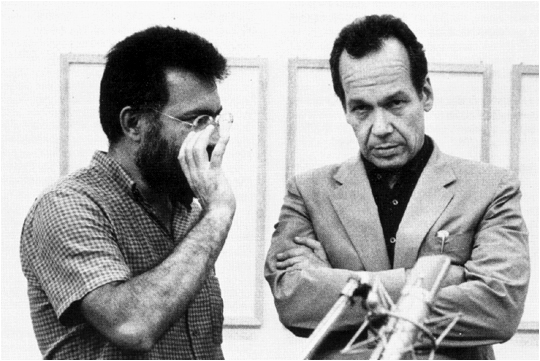
| Evan Parker & Steve Lacy | Photo: Caroline Forbes (1985) |
©
The copyrights remain with the aforesaid sources and/or with the authors.
Die Copyrights liegen jeweils bei den genannten Quellen und/oder bei den Autoren.