Massimo Ricci
Jason Bivins
Tom Sekowski
Brian Olewnick
Rigobert Dittmann
Massimo Ricci
(…) A few months back, FMP's honcho Jost Gebers was so kind to send this CD from 2002, which was previously unknown to me. Immediately upon the first try I had to declare, once again, that for all those hundreds of records reviewed on a yearly basis there's always something important that can't elude the barriers of my ignorance. "Ilinx" was recorded in different circumstances between 2000 and 2001, both in live and studio settings. The instrumentation comprises electric guitar, sampler, alto sax, drums, percussion and electronics. This is one of the finest examples of EAI before the genre became nearly fashionable (anathema!), a perfect amalgamation of original sources and modifications which sound like computer music at times, but with an acoustic feel that can almost be smelled. Maneuvering their evident technical abilities in ways that range from the polite to the borderline, the musicians generate the disbandment of collective common sense while keeping in touch with a solid logic, driving the music across the most impervious unpredictability. A parapsychology of interdependence assisting the listeners with spurts of elegant mayhem, where the need to separate timbre from pulse, rhythm, from counterpoint, is absent. A salubrious layering of instrumental redevelopment building uncertainty through intelligence, demanding equal intelligence to be understood. Satisfactory expressiveness from any conceivable angle in an important "reference point" release.
from: Touching Extremes, June 2008
Jason Bivins
Shiver me timbers, a FMP release! I thought the grand old German label was defunct, so this is nice to see. From the very start, this is rambunctious post-industrial free improv in the early ’00s Grob vein. Think Konk Pack for sure, or some similarly aggressive amalgam of electronics and European free music. Lars Scherzberg slices and dices through the field of perky electronics his session mates Serge Baghdassarians and Boris Baltschun frequently plow, framed by the rolling, Lovens-ish percussion of Jacob Thein.
This punchy approach to improvisation is especially evident on the blunt jab “Position of the Plucking Point.” My initial thought was that it speaks well of Baghdassarians and Baltschun (heard to good effect on recent releases from labels Absinth, Creative Sources and Potlatch) for throwing themselves into such a wide variety of situations; they’re resourceful and imaginative enough players (much like Thomas Lehn) to handle their business in a lusty European free improv (or efi) session like this. But then I checked the recording date: this music comes mostly from 2000 (only the tentative “Somehow metallic” was recorded in 2001).
Regardless of periodization, what about the music? There are a lot of birdsong moments where Scherzberg sets the tone (and I could swear I hear Lovens’ saw). Elsewhere, however, there are thick clusters of variety, as where Baltschun and Baghdassarians set up a nice contrast at the end of “Bridge Velocity” (crackling flames and lower register gurgling, probably a detuned guitar) or the skirling, skittering noise on “Resonators Response” (which is more hushed but still insectoid).
On some level, I appreciate the way in which Scherzberg and Thein don’t self-consciously try to modify their approach due to the presence of electronics. But this doesn’t always mean that the result is successful. Consider the snorting swine and 50s sci-fi on “Quilt” – this piece is, like many here, filled with tiny gestures that don’t really amount to much.
It’s not the case that this is simply episodic or a reflection of the group’s efi methodology; what I mean to say is that there just isn’t enough of interest here to sustain the length of the pieces. Too many times the group falls back on now very familiar techniques, resulting in music that’s impressive but a bit tedious. For example, on “Plane of Consistency” chirruping electronics are met with a Butcher-esque sax burr and scraped percussion (both rough and luxuriant). But how many tracks like this are available, and how many more are needed?
In fairness, it’s not substantively worse than a lot of other stuff in this vein, just as it’s not substantively better. But there have been an awful lot of records like this in the last 10 years. For what it’s worth, this release would likely be more impressive had it been issued promptly. If you haven’t heard much in this efi vein, you could do a lot worse than this record, but for veteran improv freaks, little here will shake you from your ennui.
from: Dusted Magazine, April 4, 2008
Tom Sekowski
At a time when the masses are dropping their first-choice instruments and trading them for laptops, the German quartet Ilinx is treading that same path, but only mid-way. Two of its members - guitarist Serge Baghdassarians and sample-magician Boris Baltschun - are converted over to the electronics medium, while alto saxophonist Lars Scherzberg and percussionist Jacob Thein are playing their first chosen instruments. From micro-tonal, through to extended techniques, the band rambles on for the first few minutes. It's only later on that they hit their stride. Problem is the ten pieces on the CD come from three separate live dates. Consistency appears to be broken. Even so, the music is played with a particular edge and wild abandon. Scherzberg is especially keen on dispersing a wad of delicately subdued breaths, while Thein delivers substantial amounts of trickling percussion in the vein of Tony Oxley. Electronics aspect is obviously heavy. Heaps of scrapes, hums and ticks escape from Baltschun's sampler. Meanwhile, Baghdassarians wraps up the sound in a concoction of warped metallic metaphors and luxuriously scraping bleeps. To make sense out of this all is next to impossible. One can only drown in the sea of four musicians who do nothing but constantly push the envelope of free improvisation down a path of self discovery. Here's hoping Ilinx will have further documents of this sort pop up in the future.
from: Gaz-Eta # 63, 2008
Brian Olewnick
An interesting kind of "nexus" recording, from three events in 2000 and 2001, with a quartet of musicians, two of whom seem to be coming from more of an EFI (European Free Improvisation) approach while two are on their way toward a more eai (electro-acoustic improvisation) take on things. With the latter field just beginning to come into its own at this point, there's certainly an amount of oil and water in play, making "Ilinx" perhaps more satisfying to observe as a kind of object lesson than as a more or less successful series of pieces.
Alto saxophonist Lars Scherzberg and percussionist Jacob Thein hold up the "traditional" FMP attack, which is to say they favor activity over reticence, anxious expressiveness over considered detachment. Guitarist / electronicist Serge Baghdassarians and sampler / electronicist Boris Baltschun occupy the other hemisphere, attempting to cool things down, to investigate purely sonic aspects while placing their discoveries within the space they reside. The twain rarely meets. Oddly, given what one assumes to be essentially an improvisatory situation, compositional credits are listed, the first five tracks sourced to either Scherzberg or Thein, the last five to the electronics pair. They may indeed be somewhat more prominent in the second half of the disc, but the general attack doesn't vary so much: chattering, a profusion of bird-like tones and an apparent goal of filling the sonic space consistently rather than introducing sounds into the mix in any subtle manner. In relation to prior FMP-style recordings, this fits in securely, the electronics providing some added spice, but essentially, it's nothing conceptually different than any hundreds of albums produced over the preceding twenty years. If Baghdassarians and Baltschun were attempting to steer their companions into different realms, they were only minimally successful, coming closest on the concluding track, "Autoreverse", where the pings and clatter mesh into something of a Tudor-esque weave that's very attractive. In that divide between EFI and eai, fans of the former may enjoy Ilinx just fine while those partial to the latter are likely to be annoyed at what Radu Malfatti famously referred to as gabbiness.
from: The Squids Ear, January 30, 2009
Rigobert Dittmann
(…) Mit ILINX, im November 2007 veröffentlicht, gelingt es Jost Gebers, nach den schmerzhaften Querelen der FMP-Abwicklung, wieder aktuelle Lebenszeichen von sich zu geben und dabei ein Quartett mit zwei Laptops in die Tradition der Free Music Production einzubinden. Dass Peter Niklas Wilson († 2003) die lesenswerten Linernotes beisteuerte, verrät, dass die Musik, die Serge Baghdassarians & Boris Baltschun an Electronics & E-Gitarre bzw. Sampler zusammen mit dem Altosaxophonisten Lars Scherzberg und Jacob Thein an Drums & Percussion machten, u. a. auf dem Total Music Meeting 2000, einige Zeit auf Eis lag. Wilson macht deutlich, wie inspirierend neben dem Geist von Webern & Cage auch der Geist aus der Maschine und der Steckdose für die Free-Improvising-Pioniere der 60er gewesen ist. Evan Parker entwickelte z. B. seine Zirkularatmung, um mit dem elektrifizierten Derek Bailey mitzuhalten, von Keith Rowe und Richard Teitelbaum gingen ähnliche Impulse aus. Rowes zweiter Frühling und die Handlichkeit von Notebooks bewirkten, dass die ‚Neue Improvisationsmusik‘ sich elektroakustisch runderneuerte. Mit Ilinx kommt ein Begriff ins Spiel, den Roger Caillois in Les Jeux et Les Hommes (1958) neben Agon, Alea und Mimikry sowie Ludus und Paidia einführte und charakterisierte als Spiele, deren Reiz besteht on the pursuit of vertigo and which consist of an attempt to momentarily destroy the stability of perception and inflict a kind of voluptuous panic upon an otherwise lucid mind. In all cases, it is a question of surrendering to a kind of spasm, seizure, or shock which destroys reality with sovereign brusqueness. Spielerisch können also Effekte erzielt werden, wie man sie ansonsten dem Erhabenen zuschreibt. Als ‚erhaben‘ lässt sich die Ästhetik von Ilinx, die den Faden von Scherzbergs Bremer Projekt X-Pol weiterspinnt, dann erfassen, wenn man mit Adorno das Erhabene als Gegensatz zum ästhetischen Hedonismus positioniert, mit einem Potential, das er Gerechtigkeit - also mehr als nur Offenheit - gegenüber dem Heterogenen nannte. Ilinx zu hören, heißt, sich einem Schauer von Splittern aussetzen, einem molekularen Hagel von elektroakustischen Partikeln, die permanente Mikroschocks auslösen, weil sie sich nicht als Syntax fassen lassen und von einer (A)-Logik des Zerfalls und polymorphen Perversität bestimmt zu sein scheinen, vor der man, nicht ohne Nervenkitzel und Lustgewinn, nur kapitulieren kann. Wilson bemüht Schillers Definition des Spieltriebs, um den Witz bei Ilinx am Ohr zu fassen zu kriegen, nämlich Werden mit absolutem Sein, Veränderung mit Identität zu vereinbaren und die Zeit in der Zeit aufheben, sprich, zu ‚sublimieren‘. Voilà, Kant, Schiller, Adorno & Caillois transformiert zum Mindfuck, ohne dass man eine Zeile von ihnen kennen müsste.
aus: Bad Alchemy # 60, 2008
| ||
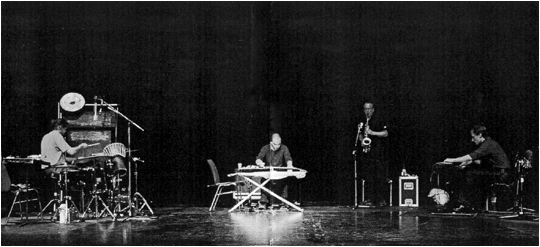
| Ilinx | Photo: Dagmar Gebers (2001) | |
©
The copyrights remain with the aforesaid sources and/or with the authors.
Die Copyrights liegen jeweils bei den genannten Quellen und/oder bei den Autoren.