Walter Schwager
Milo Fine
Martin Roeber
Reissue:
Jay Collins
Derek Taylor
Dan Warburton
Brian Morton
Nate Dorward
Rigobert Dittmann
Hans-Jürgen von Osterhausen
Walter Schwager
The commissioned piece is not band material by any stretch of the imagination. This music, recorded in 1980 for a BBC programme, is still the most advanced and the most impressive of the albums reviewed here. Stringer contains four pieces for orchestra composed by the bassist Barry Guy, and played by the London Jazz Composer’s Orchestra; it was issued by the German company Free Music Production. The roster of the LJCO reads like a Who’s Who of European avant-garde music: Kenny Wheeler, Evan Parker, Peter Brötzmann, Tony Oxley, Peter Kowald, to cite just a few. The music is remarkably fresh and challenging, consisting of shards and fragments of collective playing between more individual solos. Music of this caliber is scarce, and this record is a must for every serious listener trying to understand the European avant-garde in improvised music.
from: CODA Magazine # 229, December/January 1989/90
Milo Fine
(…) The album is divided into four parts entitled “Four Pieces For Orchestra”. Guy has come up with appealing and elastic structures and arrangements that make excellent use of the improvisational abilities of the improvisational abilities of the participants. At times the soloists don’t quite rise to the occasion, most notably Riley on “1”, Coe and Poore on “3”, and Wheeler on “2”, who seems to have a bit of trouble sustaining interest. However the greater percentage of individual work is quite powerful and/or engaging, including Brötzmann’s trademark screeching intensity on “2” (which literally jumps out of the metronome-like structure); Wachsmann’s enigmatic electronics/violin combinations which set the stage (and conclude) the floating textures of “1”; the drum duet (with Oxley also on electronics) opening “4”; bass dialogues, solos by Rutherford and Tomlinson on “4”; and some driving linear expansions from Watts on “1”.
from: Cadence Magazine # 6, June 1984
Martin Roeber
Neu im Programm der verdienstvollen Berliner Free Music Production: Das London Jazz Composers Orchestra mit „Stringer“. Barry Guy hat für die renommierte Musikervereinigung vier Stücke für großes Orchester geschrieben. Wenn man so will - fast eine Sinfonie, mit zwei kompakten, gewichtigen Ecksätzen, einer Art Adagio und einem Quasi-Scherzo. Barry Guy hat in seiner Komposition natürlich nur die wichtigen Strukturen festgelegt. Wie er selbst sagt, lebt seine Musik letztlich von der Improvisationskunst der Instrumentalisten.
„Stringer“ – angesiedelt im Grenzbereich zwischen Free-Jazz und klassischer E-Musik – ist dank des Könnens der 18 mitwirkenden Musiker, dank ihres inspirierten Spiels, zu einem Beispiel von Avantgarde-Jazz geworden, das auch Free-Jazz-Skeptiker überzeugen dürfte.
aus: WZ/Westdeutsche Zeitung, 31. Juli 1984
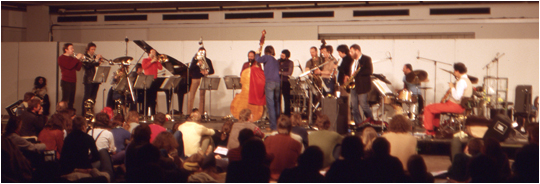
| ||
| London Jazz Composers Orchestra | Photo: Dagmar Gebers (1981) | |
About the Intakt reissue:
Jay Collins
It is a generally accepted maxim that Barry Guy’s London Jazz Composers Orchestra is indeed one of the most gripping and stylistically unique large ensembles in improvised music history. Though various reasons—economic and otherwise—have forced Guy to downsize his conception into a tentet format as of late, the LJCO’s legacy remains solid and perennially potent. With this reissue of 1983’s wonderful Stringer LP, appended here by a previously unreleased 20-minute piece from 1991, “Study II”, the final piece of the puzzle is now again available.
While the LCJO mostly drew on an A-list of British talent (Evan Parker, Henry Lowther, Paul Dunmall, Paul Lytton, Trevor Watts, Barre Phillips, etc.), Guy frequently called upon additional talents from a dense pool of European improvisers. For Stringer, originally recorded by the BBC on March 26, 1980 (and not released until 1983), there are quite a few guests of note not normally associated with this conglomeration, including Peter Brötzmann, Kenny Wheeler, and Peter Kowald, while “Study II” focuses on Conrad Bauer. Of course, Guy’s writing and arranging style is what makes this such an engrossing listen, with its mix of ensemble chaos and beauty, small group pairings, and, as expected, captivating solo improvisations. Although, as Guy’s instructive liners point out, his charts were not always met with enthusiasm by their interpreters.
On Stringer, subtitled “Four Pieces for Orchestra”, Guy attempts to create four separate events that focus on specific instrumentalists or groupings, as well as the ensemble, tied together by a somewhat obscured theme and the inspiration of Fred Hellier’s cover painting. Phil Wachsmann is the hero of its initial segment, with his heavily effected violin scraping, scrawling, and stoking the large ensemble to enormous heights. “Part II” presents the most solemn moments of the piece, with a sensitive string opening laying the groundwork for a regal Wheeler statement over the shifting horn patterns.
Following this moving passage, “Part III” contains the most intense moments of the piece, with the saxophones being the key fire-spitters. Parker takes the first brief solo, Brötzmann adds some riveting shrapnel, and then Larry Stabbins contributes gauzy burr followed by Tony Coe’s wiry clarinet, all unraveling over percussive and blustery ensemble touches. The final portion brings it all together, with various highlights being the initial percussion exchange (between Tony Oxley and John Stevens!), the Rutherford-Guy-Oxley triad, shades of Guy’s “Ode”, over which Brötzmann soars, and the concluding thunder augmented by Watts’ biting alto and the strings.
“Study II” is a group effort, highlighted by an ominous, muted horn swell at its outset, a classically-influenced venture that brings to mind modern composers, as well as the minimalism of Cage. At various points, the horns rise into a chatter and tension flutters, with the centerpiece being an exchange between Guy’s puckish bass and Conrad Bauer’s trombone that ultimately concludes in a mode similar to the opening drama. While some might quibble that this is unexpectedly tame—it may be more muted than the title piece—it is no less Guy.
Now that the London Jazz Composers Orchestra output has been reissued to the CD-buying public by Intakt, what’s next? Will the band be back some day? Will Guy continue with his compacted New Orchestra? Who knows what is lurking in Guy’s basement (or Euro radio stations, or, even in Guy’s head), but most importantly, as with other work from the LJCO, this is timeless art that is thankfully out again for us to consume.
from: One Final Note, April 17, 2006
Derek Taylor
The London Jazz Composers Orchestra remains on indefinite hiatus, victim of the twin torpedoes of finances and logistics. Founder and leader Barry Guy filled the breach with a streamlined version dubbed the New Orchestra. But even blessed with the broad merits of the reconfigured band, it’s hard not to feel pangs of nostalgia for its more populous precursor. New LJCO recordings may not be forthcoming, but this recent Intakt reissue provides two ambitious and distinct archival pieces by two different incarnations of the group.
Originally released on LP by FMP in 1980, the sectional “Stringer” makes use of what many would consider a dream roster. The reed section alone, with Watts, Parker, Brötzmann and Coe, contains enough firepower to level marble prosceniums, not to mention the bass and percussion tandems of Guy/Kowald and Oxley/Stevens. Regrettably, the BBC recording isn’t the best at capturing the band in a good audio balance. The “rhythm” section in particularly sounds somewhat distanced in the mix.
But the fidelity issues are truly a minor problem. Guy makes clever use of a myriad of combinations throughout the piece’s four parts. In the notes he describes tensions that arose from his detailed scores, several of the musicians bucking at the structured bit imposed by his charts. Those interpersonal tensions are hardly evident in the sounds and improvisation guides the action as much as the skeletal body of Guy’s composerly influence.
Detailed booklet annotations allow easy identification of who’s doing what and when, but the piece feels almost too crammed with activity, particularly in the second two parts where baton tradeoffs occur in swift succession. Among the standout passages are Wachsmann’s electronics-laced arco work in heated conversation with Oxley on the opening and close of “Part I” and a striking relay of reeds on the opening half of “Part III.”
I found myself wishing repeatedly that these passages and others had even more temporal girth to expand and develop. Miraculously, at forty-odd minutes long the piece feels short and some of the sub-groups (Parker teamed with Guy, Kowald and Stevens, for one) all but beg for greater spotlight space.
“Study II” dates from nearly eleven years later and benefits significantly from the expert engineering of Peter Pfister (a shame he wasn’t on hand for the BBC date). Structurally, it’s quite different from its predecessor. The band builds opening and closing passages that dramatically subsume individual voices. The controlled drone-like effects are both calming and starkly at odds with what you might expect from a band populated by celebrated free jazz blast furnaces like Parker and Dunmall.
As if like clockwork, cracks in the ice soon occur and the band erupts into a series of molten solos and ensembles, before freezing over once again for the finale. The contrast of order and finesse with tumult and temerity, austere cold with raging heat, makes for a very rousing listening experience. With luck, Intakt has more waiting in the vaults and plans to release it sooner rather than later.
from: All About Jazz, February 2006
Dan Warburton
Bassist / composer Barry Guy's London Jazz Composers Orchestra has been a force to be reckoned with in the world of large ensemble improvised / composed music since its debut release Ode way back in 1970 (originally on Incus, reissued by Intakt), and this latest package is also something of a retrospective, bringing together 1991's "Study II", which clocks in at just under 20 minutes, and the "Four Pieces for Orchestra" released as Stringer on Jost Gebers' FMP imprint in 1983 (and recorded three years prior to that for BBC Radio 3's Music In Our Time series at the Beeb's Maida Vale studios in London). As usual, the line-up is impeccable: saxophonists Trevor Watts and Evan Parker and trombonist Alan Tomlinson appear on both sessions, and the Stringer date also features (wait for it) Kenny Wheeler, Harry Beckett, Dave Spence, Paul Rutherford, Alan Tomlinson, Paul Nieman, Melvyn Poore, Peter Brötzmann, Larry Stabbins, Tony Coe, Phil Wachsmann, Howard Riley, Tony Oxley, John Stevens and Peter Kowald. Might as well run through the personnel on the later session while we're at it: Irène Schweizer, Henry Lowther, Marc Charig, Jon Corbett, Conrad Bauer, Radu Malfatti, Steve Wick, Simon Picard, Paul Dunmall, Peter McPhail, Paul Lytton and Barre Phillips. The booklet also includes some splendid photos of the Stringer band to remind us how old we've all got in the intervening years – but the music has aged magnificently.
I first came across Guy's work back in the – ahem – formative years when I was acquiring Lutoslawski, Ligeti, Xenakis and Penderecki vinyls at a ridiculous and irresponsible rate of knots (ask my bank manager if you don't believe me), and have always associated his large ensemble pieces more with mainstream European avant-garde as a result; the raw intensity of the surging brass clusters, spidery strings (complete with added electronics), Darmstadt freakout piano (courtesy Howard Riley) and double-headed percussion assault (Oxley and Stevens – talk about being spoilt) still have much in common with some of Penderecki's semi-graphic scores of the 60s and 70s, though the Polish composer would have had a hard time notating the extended technique pyrotechnics of Messrs Parker and Brötzmann. This is music of mass effect rather than note-to-note detail, in which pitches function more as black holes than suns, sucking in adjacent clusters and blusters; even the ostinato that underpins Stringer's second movement (there are twelve notes but not all twelve notes of the chromatic scale – it's not a series), which is gently displaced against itself in canon to form a backdrop to a spectacular solo feature for Kenny Wheeler, serves as a reservoir of intervals for the trumpeter to draw on rather than a blueprint for any kind of serial development as such.
Guy's liners astutely point out the differences between the two sessions, specifically the fact that Peter Pfister, recording "Study II" in Zürich in 1991, used individual close up mics as opposed to producer Stephen Plaistow's "symphony orchestra perspective" on Stringer. Not that it makes a huge difference, but there are a few bright flashes of trumpet (Lowther?) and trombone (Bauer?) in the later recording that stand out rather more than they might have done at the Maida Vale session, in which even the apocalyptic splutters of Brötzmann are kept at a safe distance. It's a shame perhaps that the outstanding solo tuba and clarinet work in the third movement isn't a little more prominent, but let's not complain: this music has been out of print for far too long and it's great to see it out and about again
from: ParisTransatlantic, February 2006
Brian Morton
At the end of its first decade, The London Jazz Composers Orchestra had effectively purged itself of the 'jazz' component and was already moving into a phase where the dialectic of written to improvised music was not just the premise but the irreducible substance. Stringer (Four Pieces For Orchestra) comes from that time. Recorded in 1980 at the BBC's Maida Vale and released as an FMP LP, it had an odd, slightly remote quality that is dramatically improved in this remastering, almost a different piece. The drama of instrumental groups and solo order is recontextualised. Study II is more recent, but still from LJCO's past, a soaring piece for trombonist Connie Bauer.
from: The Wire # 265, March 2006
Nate Dorward
This CD represents a tying-up of loose ends for the now-disbanded LJCO, coupling the previously unreleased Study II (1991) with the long out-of-print Stringer (FMP, 1980). As often with Guy’s work, there’s a sense of multiple structures simultaneously in play: Stringer is at once a balanced four-part structure loosely echoing symphonic form, and a dense network of personal/musical/social connections. Among other things, the piece juxtaposes multiple editions of the Spontaneous Music Ensemble (Stevens, Watts, Parker, Kowald, Wheeler, and Rutherford are all present) and brings it into collision with the Howard Riley Trio (Riley and Oxley are here too). The disc is also notable for Peter Brötzmann’s sole LJCO appearance, effortlessly outshouting the entire 18-piece ensemble. Study II is by contrast one of Guy’s simplest and most mysterious compositions – in Guy’s words, it’s “about breathing, building, opening-up and returning.” Both pieces mark key stylistic turning-points for the LJCO, and while atypical of its output are no less enjoyable for that.
from: Exclaim, 2006
Über die Intakt Wiederveröffentlichung:
Rigobert Dittmann
Intakt (Zürich) bringt mit Study II, Stringer zwei tolle Aufnahmen mit dem LONDON JAZZ COMPOSERS ORCHESTRA für Ohren, die sich, wie meine, nicht an orchestraler Blasmusik satt hören können. Während ich Stringer, 1980 bei BBC aufgenommen, schon als 1983er FMP-LP in den Händen hielt, wird die Study II, 1991 im Züricher Radio Studio DRS mitgeschnitten, nun erstmals zugänglich. Beide belegen den besonderen Impetus von Guy, Möglichkeiten zu testen, große Klangkörper zu organisieren, ohne den Faktor Freiheit zu eliminieren. Die 18- bzw. 17-köpfigen Orchestras von 1980 & ‘91 weisen kaum Überschneidungen auf, nur Trevor Watts, Evan Parker, Philipp Wachsmann & Guy selbst sind sowohl als auch beteiligt. Überhaupt zeigt sich, dass Guy mit dem LJCO eben nicht ein bewährtes Konzept immer nur variierte. Study II z.B. dreht sich fast meditativ und repetitiv um Atemzüge, ein dröhnminimalistisches, immer wieder sich großartig steigerndes Ein und Aus, Sich-Öffnen & -Schließen, Sonnenauf- & Untergang, und lässt den Spielern die Freiheit, sich beim 'Öffnen‘ & ‚Loslassen‘ improvisatorisch zu entfalten. Um dann wieder einzukehren bei einem Ruhepol, einem Fokus der Entspannung, wobei Conny Bauers Posaune im Duett mit dem Kontrabass eine prominente Rolle zukam. Die Four Pieces for Orchestra aka Stringer dagegen zeichneten sich aus durch ein besonders umfangreiches Konvolut an Notenmaterial und detaillierte Vorschläge für das Was und Wie. Die 'Mitkomponisten‘ waren durch Informationsfülle einigermaßen konsterniert. Dennoch setzten sie Guys Ambition, eine viersätzige symphonische Form in einem molekular-egalitären Kontext auszureizen und mit verdoppelter Rhythmsection (Guy & Kowald, Oxley & Stevens) und glänzender Brasspower den Unterschied zu unterstreichen zwischen einem 'bombastischen‘ Erhabenen, das einen mit der Macht des Schicksals erschlägt, und einem sublimen, das prachtvoll schillernd auf einen offenen Horizont hin führt, mit dem Feuereifer um, der dieser Fire Music erst das Zündende gibt. Stringer lebt vom Kontrast zwischen individueller Gischt und einer im getragenen Tutti dahin fließenden überpersönlichen Grundströmung, die man als Natur, Geschichte oder Kollektiv lesen könnte. Der Nachhall von Guys Experimenten mit internen, auf Persönlichkeit und Eigenkreativität basierenden Fäden und Korrespondenzen und permanent changierenden 1-, 2- 3- & 4-kernigen Nuklei, ist bis hin zu Brötzmanns Chicago Tentet, Atomic/School Days und der Territory Band zu hören. In Stringer, das übrigens Bezug nimmt auf ein informelles, an Tàpies erinnerndes Gemälde von Fred Hellier, und zeigt, dass Guy sich schon früh mit Fragen einer nichthierarchischen Organisation von Fläche, 'Farbe‘ und Raum in der Zeit beschäftigte, verlegt er, nicht zuletzt mit Wheelers Trompetensolo in Part II, den Fidelio-Ton, der schon Bloch so begeistert hat, in die Organisation der Musik selbst. So, dass sich der ethische Effekt, den auch Pettersson, Ruders oder die Spektralisten rein klanglich erzielen, schon aus der von unten her organisierten Machart der Musik entwickelt, aus dem Geist und dem in den Parts III & IV in immer prächtigerer Kakophonie ineinander züngelnden Feueratem der Einzelnen.
aus: Bad Alchemy, Januar 2006
Hans-Jürgen von Osterhausen
Barry Guys London Composers Orchestra gehört zu den alten Intakt-Stammkunden, Guy mit seinem Gesamtwerk gleich gar. Mit 14 Aufnahmen ist er im Katalog vertreten.
Mit der neuen CD „Study II, Stringer“ greift Guy zwei seiner älteren Aufnahmen auf, die den Weg seiner großorchestralen Kunst sehr gut belegen.
Bert Noglik skizziert Guys Konzept sehr treffend, wenn er darauf verweist, dass Guy die Idee der europäischen Sinfonie verbindet mit dem in der Musikgeschichte mehr oder weniger vergessenen Phänomen des spontanen Musizierens. Genial löst Barry Guy diese Aufgabe, lässt bei aller vorgegebenen Struktur der Individualität der Musiker viel Raum, ihren Klangideen wie Gestaltungen. Insoweit greift er auf die Konzeption des Jazz zurück, löst sich aber sehr deutlich von diesem durch die neuen Strukturen, die eher der Neuen Zeitgenössischen Musik zuzuordnen sind. Insoweit bezieht Barry Guy mit seinem Werk, auch und vor allem mit dem London Composers Orchestra, das das erhebliche kleinere New Orchestra inzwischen abgelöst aber nicht ersetzt hat, eine ganz eigene unverwechselbare Position im musikalischen Zeitgeschehen, das seit vielen Jahren von Intakt Records dokumentiert und weltweit bekannt gemacht wird.
Mit „Stringer“, einem vierteiligen Konzert für Orchester, ist Guy noch deutlich näher an der Entstehung des im Jahr 1970 aus der Taufe gehobenen Orchesters, während „Study II“ viele feste Strukturen aufgegeben hat. Heraus sticht ein langes Solo des Posaunisten Conny Bauer. Monumental wie die Musik in ihren leisen wie großorchestralen, vollmundigen Phasen ist die Liste der beteiligten Musiker, z.B. Irène Schweizer, Henry Lowther, Radu Malfatti, Trevor Watts, Evan Parker, Paul Dunmall, Philipp Wachsmann, Barre Philips, Peter Kowald, Howard Riley, Tony Oxley und so weiter und so weiter.
aus: Jazz Podium # 4, April 2006
©
The copyrights remain with the aforesaid sources and/or with the authors.
Die Copyrights liegen jeweils bei den genannten Quellen und/oder bei den Autoren.