Mark Sinker
Milo Fine
Mark Sinker
(…) Chirps records an evening of improvisation with another soprano master, Evan Parker. Dense, closely woven, it’s a moment-to-moment tiptoe, two irreducible bodies exploring each other’s thought and practice. “Parker compromises most”, says a colleague, meaning Lacy appears to call the shots. I wonder. Parker’s course, as he follows and mimics Lacy’s lines, seems to be to turn Lacy into another part of his own Voice: if the music is sometimes uncannily like two Steve Lacys circling, at other times it feels as if they’ve combined into one Evan Parker in full polyvocal flow. When the audience finally applaud, they seem stunned, hypnotized.
from: The Wire # 36, February 1987
Milo Fine
“Chirps” indeed. Lacy and Parker come on like two spiraling birds in deep conversation, simultaneously listening and reacting as if their ears were attached directly to their horns. The basic material/vocabulary here is Lacy’s (angular evolving lines and riffs, replete with those almost patented intervallic explorations and colored with touches of “pure” sound), with Parker seemingly giving affectionate deference to the “old man of the straight horn.” Hence, the overall effect is more shadow play than the stylistic counterpoint one might expect from this pairing, though Parker does, from time to time, dip into his sputtering multiphonics layers.
It is interesting to note Parker’s adaptability. On most recordings he has remained firmly entrenched in his specific avant-scientific methodology, though; in recent times he has seen fit to publicly reassess “the tradition”. (This trend has, of course, been going on in America for quite some time with European players like H. Bennink, Mengelberg, Altena, el, al, getting into it as well – the results in many cases being mixed at best.) In fact, Parker’s work here almost out-Lacys Lacy technically (though not in terms of feeling – Parker, in a sense, becoming more and more of a cerebral tactician overall) in his execution of the Monk-rooted material here. But the feeling of a “cutting contest” never enters the proceedings. Nor are there any empty virtuostic displays. It is, quite simply, a musical dialogue in every sense of the word.
from: Cadence Magazine # 7, July 1987
see/siehe: Reviews/Rezensionen CD-Edition FMP CD 29
 |
|
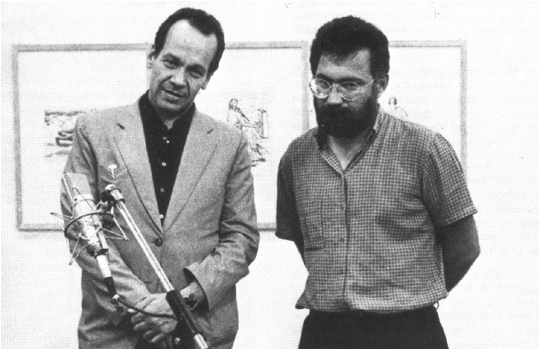
| Steve Lacy & Evan Parker | Photo: Caroline Forbes (1985) |
©
The copyrights remain with the aforesaid sources and/or with the authors.
Die Copyrights liegen jeweils bei den genannten Quellen und/oder bei den Autoren.