Bob Rusch
Jürg Solothurnmann
Reissue:
Jochem van Dijk
Jay Collins
Ken Waxman
Hans-Jürgen von Osterhausen
Bob Rusch
Buschi Niebergall turns up on a trio with Gerd Dudek and Edward Vesala called Open. The six tracks were recorded at the Free Music Workshop in Berlin 1977. If you like structured free interplay, you’ll get your money’s worth here, both in time and performance. For the most part the music here maintains a competent, even level of hard sax dominated trio Jazz but on “Open” with Dudek on flute, the trio explores with greater equanimity the improvised adventure and a detachment that prevailed over much of the record falls away as the players truly open up their mental techniques to match their physical techniques. A ‘good’ date with some individual high peaks.
from: Cadence Magazine # 8, August 1979
Jürg Solothurnmann
Diese Trioplatte macht den Eindruck einer freien musikalischen Zusammenkunft ohne besondere Abmachungen und hat dementsprechend ihre Qualitäten und Schwächen. Ein Thema oder Kopfmotiv als Ausgangspunkt ist nur in „Manchmal“ feststellbar. Einige der „Stücke“ sind möglicherweise sogar nur Ausschnitte aus längeren Improvisationen. Die Aufnahme dokumentiert eine bestimmte Spielweise und Situation, aus der sie spontan entstand, aber wirkt auf mich weniger zwingend, als wenn ich am Ort des Entstehens Teilhaber der Stimmung wäre. Zudem sind sich die einzelnen Stücke konzeptionell doch ziemlich ähnlich. Dudek, ursprünglich von Coltrane herkommend, benutzt in panmodaler Manier allerlei Tonleitermaterial, das er, dem Bewusstseinsstrom folgend, aufgreift und wieder fallen lässt. Nicht nur auf der indischen Shenai (die er, offenbar autodidaktisch erlernt, in eher nahöstlicher Weise benutzt) lässt er eine gewisse Neigung zu orientalischen Skalen und Verzierungen erkennen. Auf allen Instrumenten, auch der vogelartig trillernden Flöte, ist Dudek er selbst. Niebergall und der Finne Vesala bauen zwei- und mehrschichtige Rhythmus- und Klangebenen auf. Niebergall arbeitet vorwiegend mit verschliffenen Pizzicatotönen und tremolierenden Mehrklängen und Vesala mit großen kreisenden Bewegungsabläufen. Hier hört man drei erfahrene und technisch versierte Solisten, von denen man jedoch weiß, dass sie mit etwas mehr Überlegung ein Album aufnehmen könnten, das stärkere Kontraste, mehr Geschlossenheit und weniger zufälligen Charakter aufweist.
aus: Neue Zeitschrift für Musik # 5, September/Oktober 1979
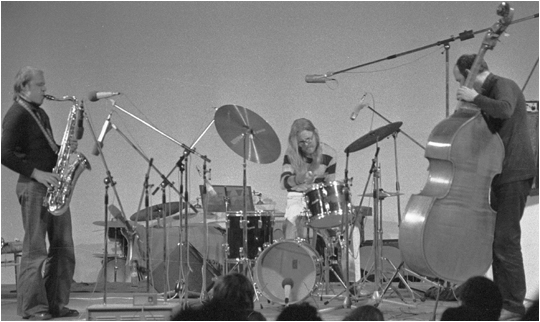 |
|
| Gerd Dudek / Edward Vesala / Buschi Niebergall | Photo: Dagmar Gebers (1977) |
About the Atavistic reissue:
Jochem van Dijk
As part of its Unheard Music Series, Atavistic has reissued Open, a free improv recording from 1977 made in Berlin by European improvisers Gerd Dudek (reeds), Buschi Niebergall (bass) and Edward Vesala (drums). This is a first-time-on-CD reissue, with no hope of a reunion: Niebergall, a mainstay on the Euro-scene of the seventies, seems to have disappeared into oblivion to the extent that his death “somewhere” in the '80s is his only known personal detail. Vesala passed away in 1999.
Born Martti Vesala in Finland, the drummer made several highly acclaimed records for ECM with his tightly led Sound & Fury ten-piece band. A tireless composer, thinker and influential musician, he shows himself on this record first and foremost to be a topnotch sideman and drummer with huge ears, great energy and a wide-ranging textural sensitivity, both in his own highly dynamic playing and his obvious attention to the whole of the group's sonic texture. Through his concentrated performance he steers and shifts the color of the ensemble and density of playing almost all by himself, or in strong cooperation with bassist Niebergall, as can be heard in their tom-tom and bowed tremolo bass buildup on “Mira.”
Gerd Dudek (who is still among us; he made his first album as a leader two years ago at the age of 63) plays a very clean and linear game. In his style the fruits of a highly melodic imagination grow on a sturdy foundation of jazz chops, without ever giving in to “running” scales or arpeggios. His soprano sax playing, in particular, as on “H.S.,” is quite impressive, with a strong, deep, squeak-free tone and on-the-spot intonation. It lends his playing a Dolphy-ish character and sets it apart from the usual Coltrane rip-offs. The title tune, with very inspired multi-timbral flute work by Dudek, is an amazing trip that takes the listeners and musicians to all almost every corner imaginable: a monster effort by the whole group.
The music on Open is a true improviser's almanac. The lack of predictability goes hand in hand with a concentration that never lets off, and the players have each other by the throat all the time, so to speak, leading to an intensity that doesn't quit. This great reissue contains some of the best improvising and ensemble playing I have heard in a long, long time, serving as a reminder of how great free playing can be—or used to be?
from: All About Jazz, January 17, 2005
Jay Collins
(…) Until 2002, reedist Gerd Dudek had never released a recording under his own name. That recording, 'Smatter, presented Dudek in an unexpectedly relaxed 1998 London studio setting. On the UMS reissue of Open, Dudek collaborates with bassist Buschi Niebergall and drummer Edward Vesala for a six-song program presented at Berlin's 1977 Free Music Workshop. Each of the six pieces allows Dudek to display his facility on his chosen reeds—tenor and soprano saxophones and flute.
Touching off is his fluid soprano work on the record's opening track, "H.S.", as the loose atmosphere essentially takes shape thanks to Niebergall's spidery bass work and Vesala's open-ended pulse. Likewise, the closing piece, "Chain", presents feisty soprano flights alongside a roiling rhythmic reinforcement. Dudek displays his spiritual aims on "Mira", where his wiry flute tones lead to the session's highest highs, especially after he picks up his soprano for some concluding words. The almost twelve-minute title track, though, is the focal point for the display of Dudek's flute technique, especially when he vocalizes through the mouthpiece. Finally, Dudek's most biting lines emerge during the tenor sax excursions of "Kugel" and "Manchmal". His harmonically rich and edgy style fits in particularly well as the rhythm section stokes the fires. Overall, a strong summit meeting that provides further evidence of Dudek's improvisational strengths and why his name appears on so many important European Free Music releases. (…)
from: One Final Note, November 2004
Ken Waxman
From an older generation of German jazzmen than then-tyro firebrands like Peter Brötzmann and Peter Kowald, in the mid-1960s reedist Gerd Dudek along with other key members of trumpeter Manfred Schoof’s hard bop quintet joined in exploring Free Jazz.
Yet this FMP Archive Edition reissue from 1977 was the first session made under the saxophonist’s own name. Listening to how Dudek -- born in 1938 -- runs the changes along with his two, since deceased sidemen -- Finnish drummer Edward Vesala and German bassist Buschi Niebergall --you see why his highest profile came as a member of ex-Schoof pianist Alexander von Schlippenbach’s Globe Unity Orchestra.
To put it bluntly, Dudek was a consummate freebop sideman rather than a soloist or a bandleader. Aptly compared to American hard bop tenor saxophonist Clifford Jordan -- maybe Hank Mobley would be a better match -- he proves here that he can excite an audience during a live date. But as respectably as the three play, there’s a certain distance from the kind of rapturous spontaneity that someone like Brötzmann has, and a tenacious attachment to their sources that more accomplished stylists lack keeps the trio out of the front ranks.
Frankly, the eye-opener here is Vesala (1945-1999). Looking in the booklet picture like a member of Supertramp with his past-the-shoulder hair, beard and round glasses he sounds more like Elvin Jones reacting to Dudek’s John Coltrane. Later he would go on to record sessions for ECM featuring horn sections and guitars, but his powerful, stripped-down rhythm easily motives all six selections. Niebergall participated in the classic scream-fest Machine Gun, but his simple accompaniment here merely allows the soloists to have their say.
Unfortunately, despite splitting his solos among many reeds, Dudek’s lead lines are mostly derivative. On soprano it often seems as if he’s about to work up to a version of “My Favorite Things” for a Coltrane tribute. On flute his pinched flightiness could be a cross between Paul Horn recording at the pyramids and Charles Lloyd at the Monterey Jazz Festival. At various time he’ll blow complementary lines with the flute and the harsher, grainier shenai, often vocalizing at the same time. But the effect only reminds you of how many others have attempted the style since Rahsaan Roland Kirk pioneered it at the beginning of the 1960s. Dudek’s double-tongued New Thing shrieks on tenor are zestful, but by 1977, even Brötzmann and Pharoah Sanders were tempering outbursts like that with other -- more individual -- soloing.
There are many things to like on OPEN, from Dudek’s silvery flute gusts to Niebergall studied ponticello accompaniment to Vesala’s workouts on snares and toms, but others have done that as well. The disc may appeal to collectors and those who want yet another shot of German Free Jazz, somewhat tempered by age. Alternately, if resolute players like Jordan and Mobley who try harder even though they never reach first rank are you thing, then there are many moments to savor here.
from: JazzWord, February 14, 2005
Über die Atavistic Wiederveröffentlichung:
Hans-Jürgen von Osterhausen
Im April 1977 konnte man Gerd Dudek mit dem Bassisten Buschi Niebergall und dem Schlagzeuger Edward Vesala aus Finnland beim Workshop Freie Musik, dem „Konkurrenzunternehmen“ der Berliner Jazztage in der Akademie der Künste (West) erleben. Dudek ist eigentlich bei allen wesentlichen Ereignissen der Free-Jazz-Revolution dabei gewesen, hat durch seine furiosen Auftritte begeistert, ist nie von der Stelle gewichen, war aber nie einer der Wortführer, der den Glanz des öffentlichen Interesses auf sich zieht. Erlebt man ihn heute, hat sich dies eigentlich nicht geändert. Er zeigt mit dieser Aufnahme einer der wenigen unter seinem Namen – dass er einer der herausragenden Saxophonisten des Aufbruchs in eine neue Jazzwelt war. Kraftvoll und immer virtuos, geradezu atemlos sind seine großen und nachhaltigen musikalischen Bilder, egal ob mit Sopran-, Tenorsaxophon oder Flöte.
Hört man den kraftvollen gestrichenen wie gezupften Bass Niebergalls, so weiß man, was angesichts seines frühen Todes im Jahr 1992 bis heute fehlt. Edward Vesalas Spektrum ist immer sehr breit gewesen, reichte von Jan Garbarek bis hin zum Free Jazz. Rastlos seine Trommelwirbel, die das Geschehen sprichwörtlich mit dem „Paukenschlag“ vorantreiben.
Auch diese sicherlich weitgehend vergessene Aufnahme ist eine Perle in der europäischen Musikgeschichte. Dass mit ihm immer noch zu rechnen ist, hat Dudek im Übrigen im Rahmen des letztjährigen JazzFestes Berlin bewiesen.
aus: Jazz Podium # 5, Mai 2005
©
The copyrights remain with the aforesaid sources and/or with the authors.
Die Copyrights liegen jeweils bei den genannten Quellen und/oder bei den Autoren.